Wednesday, July 18, 2018

Open Air Burning and COPD (To Council, #4)

You probably know someone who is suffering from COPD; more than 10% of Canadians over the age of 35 are living with it.

Wood smoke can cause COPD, precipitate flare-ups, and lead to death.
Here’s what the Lung Association has to say:

Chronic Obstructive Pulmonary Disease (COPD) is a lung disease that includes chronic bronchitis and emphysema.
In 80-90% of cases, it is caused by smoking. Other causes of COPD can include:
  • genetic reasons (alpha-1 antitrypsin deficiency)
  • occupational dusts and chemicals
  • second hand smoke
  • frequent lung infections as a child
  • wood smoke and other biomass (animal dung, crop residues) fuel used for cooking. https://www.lung.ca/copd
Breathing in wood smoke can cause increased respiratory symptoms, increased hospital admissions, exacerbation of asthma and COPD, and decreased your ability to breathe normally. If you have a lung disease, breathing in wood smoke can make your disease worse and cause a flare-up.
PM2.5 (inhalable particulate matter less than 2.5 microns in diameter) - PM2.5, which consists of a mixture of microscopic particles of varied size and composition, has been declared a toxic substance under the Environmental Protection Act. These particles can be inhaled deep into the lungs, leading to serious respiratory problems, including excess mortality, especially among those with pre-existing cardiopulmonary illness.

So we can add COPD to our growing list of health problems (cancer, diabetes, heart attacks) linked to PM2.5 and wood burning.

How can Woodstock Council justify the practice of open air burning?

The above text was sent by e-mail to each member of Council on July 18, 2018.


Wednesday, July 11, 2018

Open Air Burning and Heart Attacks (To Council, #3)

Saturday July 7 was a horribly smoky, unpleasant evening in my neighbourhood here in Woodstock.

Are you aware that wood smoke causes heart attacks?

The results of a recent Canadian study are summarized here:
“By comparing pollution data from three cities in British Columbia (Prince George, Kamloops and Courtenay/Comox) with hospital admissions, researchers from McGill and Health Canada found that rising concentrations of fine particulate air pollution caused by wood burning were associated with increased hospitalization for myocardial infarction. During the cold season, when pollution from woodstoves is at its highest, the risk of heart attacks among subjects of 65 years and older increased by 19%.
“We noticed that the association was stronger when more of the air pollution came from wood burning, says McGill University professor Scott Weichenthal, lead author of a new study published in Epidemiology.”

Here’s a statement from the American Heart Association:
“In sensitive populations, exposure to PM2.5 for even a few hours or days can trigger cardiovascular disease-related deaths from heart attack, stroke, arrhythmia, sudden cardiac arrest, and heart failure. Short- term increases in PM2.5 levels lead to the early death of tens of thousands of Americans every year.”

PM2.5 is a carcinogen.
PM2.5 increases the risk of developing diabetes.
PM2.5 causes heart attacks.
PM2.5 is a major component of wood smoke.

How can Woodstock Council justify the policy of open air burning?


The above text was sent by e-mail to each member of Council on July 11, 2018.


Wednesday, July 4, 2018

Open Air Burning and Diabetes (To Council, #2)

Last week I wrote to you about the cancer risk for residents due to exposure to wood smoke and one of its components, fine particulate matter (PM2.5).

This past Friday a new study was published in The Lancet Planetary Health, that links PM2.5 with DIABETES.

From CNN’s report on the study:

"There's an undeniable relationship between diabetes and and particle air pollution levels well below the current safe standards," said senior study author Dr. Ziyad Al-Aly, an assistant professor of medicine at Washington University.
“Particulate or particle air pollution is made up of microscopic pieces of dust, dirt, smoke and soot mixed with liquid droplets. The finest particles regulated by the EPA are 2.5 micrometers; to put that in perspective, a strand of human hair is 70 micrometers, or more than 30 times larger.
Anything less than 10 micrometers can not only enter the lungs, it can pass into the bloodstream, where it is carried to various organs and begins a chronic inflammatory reaction thought to lead to disease.”

From the study itself:
“The global toll of diabetes attributable to PM2·5 air pollution is significant. Reduction in exposure will yield substantial health benefits.”

8 years ago, the Sentinel Review reported that residents of Oxford County were already at a higher risk of diabetes, due to obesity.

PM2.5 is a carcinogen.
PM2.5 increases the risk of developing diabetes.
PM2.5 is a major component of wood smoke.
How can Woodstock Council justify open air burning?

I await your response.

The above text was sent as an e-mail to each member of Woodstock Council on July 4, 2018.

Wednesday, June 27, 2018

Open Air Burning and Cancer (To Council, #1)

On calm summer evenings, many Woodstock neighbourhoods are filled with wood smoke from backyard fire pits.

I would like each member of Council to spend a few minutes perusing a report entitled “Environmental Burden of Cancer in Ontario”, a joint publication from Public Health Ontario and Cancer Care Ontario, available on the internet.
https://www.publichealthontario.ca/en/eRepository/Environmental_Burden_of_Cancer_Key%20Messages_2016.pdf
https://www.publichealthontario.ca/en/eRepository/Environmental_Burden_of_Cancer_in_Ontario_2016.pdf

This report ranks 23 environmental carcinogens, and concludes that 3 of those carcinogens are responsible for 90% of new environmental cancer cases in this province.
One of the top 3 carcinogens is FINE PARTICULATE MATTER (also known as PM2.5), and it is a key component of WOOD SMOKE.

BY ALLOWING OPEN AIR BURNING, WOODSTOCK COUNCIL IS THEREFORE INCREASING THE CANCER RISK FOR EVERY RESIDENT OF THIS COMMUNITY.

One of the reduction strategies for PM2.5 given in the report is “increasing the distance between areas with concentrated combustion emissions and where people live and work.” [p.5] 
Clearly, fires shouldn’t be burning in backyards.

You should notice how far down the list are other substances commonly recognized as carcinogenic, such as asbestos, formaldehyde, and second-hand tobacco smoke.  Consider, too, that there is no way to avoid inhaling wood-smoke-polluted air from a neighbour’s fire pit.

Backyard fires are illegal in many Ontario cities, including Guelph, Waterloo, Brantford and Cambridge.

In light of the cancer risk, I would appreciate hearing your justification for continuing to allow open air burning in Woodstock.

The above text was sent by e-mail to each member of Woodstock Council on June 27, 2018.

Sunday, December 3, 2017

The holiday tradition we would be better off without (2nd edition)


Quiz:  What holiday tradition is bad for everyone's health, and also bad for the planet?
Hint:  "Chestnuts roasting on an open fire..."

Yes, that cheerful wood-burning fireplace that confronts us everywhere in image and song at this time of year, is actually a little toxic incinerator.

Burning wood, leaves, or any other biomass releases carbon and other greenhouse gases into the atmosphere, but perhaps the deadliest component of wood smoke is fine particulate matter (PM2.5).

In a joint publication, Public Health Ontario and Cancer Care Ontario identified PM2.5 as the third greatest environmental carcinogen in this province (way ahead of asbestos, formaldehyde, and second-hand tobacco smoke, for comparison).  Solar UV radiation and radon claimed the first two spots.
If that isn’t enough bad news, a recent study funded by Health Canada and conducted in B.C., found that heart attacks in seniors increased as the level of PM2.5 in the air increased.

This festive season, could we consider the health of everyone around us, and NOT light the fireplace?

Peace, goodwill, clean air, and good health to all.

References:
Public Health Ontario/Cancer Care Ontario.  The Environmental Burden of Cancer
https://www.publichealthontario.ca/en/BrowseByTopic/EnvironmentalandOccupationalHealth/Pages/Environmental-Burden-of-Cancer-ON.aspx

Biomass Burning as a Source of Ambient Fine Particulate Air Pollution and Acute Myocardial Infarction
https://www.ncbi.nlm.nih.gov/pubmed/28177951

Earth Institute, Columbia University.  The damaging effects of black carbon.
http://blogs.ei.columbia.edu/2016/03/22/the-damaging-effects-of-black-carbon/

Thursday, October 26, 2017

Heart & Stroke Foundation sends the WRONG message


What's wrong with this picture?


The Heart & Stroke Foundation's brochure advertising their 2017 lottery includes an image of a three-generation family sitting lakeside...AROUND A FIRE PIT!
Yes, yes, the device pictured is actually fuelled by propane, but that fact is disguised by a metal surround, presumably to make it look like the (authentic) wood-burning kind.

The message couldn't be more off base, unless the adults were passing cigarettes to the kids ("Let me light that for you, and then I'll teach you how to inhale!").

It's hard to believe that no one at H&S is aware of recent research connecting wood smoke with cardiovascular issues, such as the study done in B.C. and funded by Health Canada, that found increased levels of fine particulate matter were associated with increased heart attacks in seniors: http://journals.lww.com/epidem/Citation/2017/05000/Biomass_Burning_as_a_Source_of_Ambient_Fine.5.aspx

H&S does have a Position Statement buried on their website entitled "Air pollution, heart disease and stroke", but it hasn't been updated since 2009, and the dangers of burning wood/inhaling particulate matter aren't mentioned in any of the "healthy lifestyle choice" advice offered up front.

The issue is even more disturbing when one considers that the person who disregards all the conventional advice offered on the H&S website (concerning weight, diet, exercise, smoking, medical attention), probably puts only their own health at risk, while the person who regularly burns wood damages the health of their entire community.

It would be wonderful to see the Heart & Stroke Foundation redeem itself from this faux pas by launching a wood-smoke-awareness campaign.

Sunday, October 15, 2017

Message to WEAC

Oh, the irony!
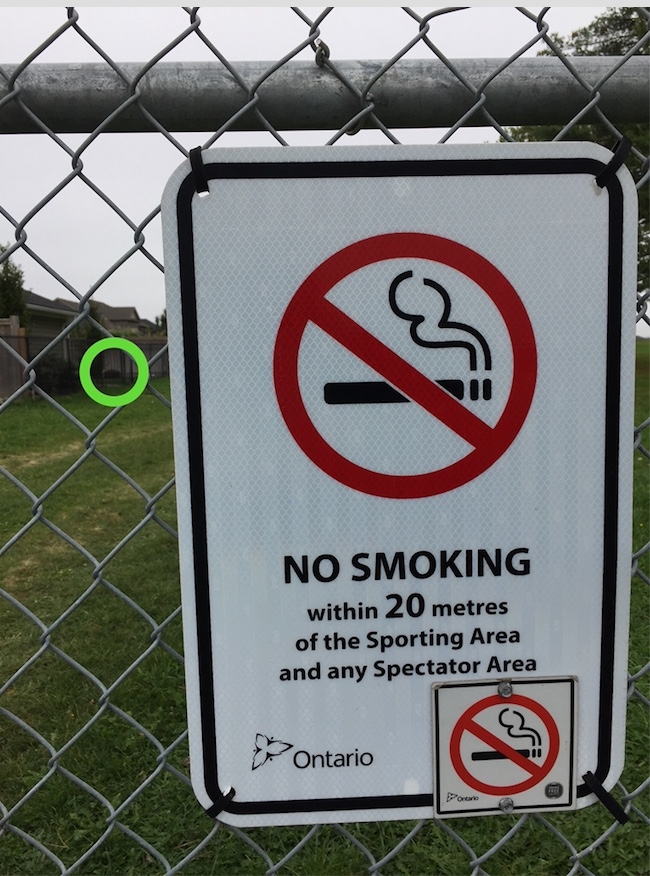
Sign at Cowan Park, with fire pit in background.


e-mail sent July 2017:

Hello, members of WEAC
It has been over a year since I last had occasion to comment on your agenda, so I will once again touch base with you and share some thoughts.
Last July the subject of your Green Tips column in WOW was smog, to which I responded with a UR opinion piece published in the Sentinel Review on July 26, 2016; it's also on my blog, with your column reproduced for reference:  https://cleanairforwoodstock.blogspot.ca/search?updated-max=2016-08-13T08:41:00-07:00&max-results=7
Needless to say the dangerous and highly polluting practice of open air burning continues to be legal in Woodstock, and what I called "the general level of ignorance regarding wood smoke" prevails (see the post "Would you do this to YOUR grandmother?", which includes an excerpt from the MOECC's website):  https://cleanairforwoodstock.blogspot.ca/

Today I would like to bring to your attention the website of Doctors and Scientists Against Wood Smoke Pollution:  http://woodsmokepollution.org
I encourage each of you to explore the material presented under the "Health", "Residential Sources" and "Environment" tabs, including the extensive bibliographies of scholarly articles.
You might then wish to ask yourselves why WEAC continues to tolerate a practice as damaging to human health and to the environment as open air burning.

I look forward to your response.


In that e-mail I provided links to three sites:
1) the website of DSAWSP, which includes a bibliography of over 400 articles regarding wood smoke, which I encouraged you to explore
2) Pictures and story of the campfire event held at Woodingford Lodge in September of 2016
(and if this event didn't horrify you, you need to review the previous information)
3) my critique of WEAC's Green Tips column on smog, from July 2016

To which I would like to add one comment:  the column discourages driving and idling.
Research done in California where they studied the impact of beach bonfires concluded:
"The particulate emissions rate per minute from one beach bonfire is equal to that from:
Three average big-rig diesel trucks; or
The secondhand smoke from 800 cigarettes. Wood smoke contains many of the same toxic chemicals as secondhand cigarette smoke.
Also, one fire pit in one evening emits as much fine particulate pollution (PM2.5) as one big-rig diesel truck driven 564 miles."
http://www.aqmd.gov/home/library/public-information/2013-news-archives/fire-pit-board-decision

There has been a lot of new information about fine particulate matter since Woodstock's Bylaw was passed in 2013.
This is what the MOECC says:
"Exposure to fine particulate matter has been associated with hospital admissions and several serious health effects, including premature death. People with asthma, cardiovascular or lung disease, as well as children and elderly people, are considered to be the most sensitive to the effects of fine particulate matter. Adverse health effects have been associated with exposure to PM2.5 over both short periods (such as a day) and longer periods (a year or more)."
http://airqualityontario.com/science/pollutants/particulates.php

The World Health Organization, on particulate matter:

"PM10 and PM2.5 include inhalable particles that are small enough to penetrate the thoracic region of the respiratory system. The health effects of inhalable PM are well documented. They are due to exposure over both the short term (hours, days) and long term (months, years) and include:
• respiratory and cardiovascular morbidity, such as aggravation of asthma, respiratory symptoms and an increase in hospital admissions;
• mortality from cardiovascular and respiratory diseases and from lung cancer.

Susceptible groups with pre-existing lung or heart disease, as well as elderly people and children, are particularly vulnerable. For example, exposure to PM affects lung development in children, including reversible deficits in lung function as well as chronically reduced lung growth rate and a deficit in long-term lung function (4). There is no evidence of a safe level of exposure or a threshold below which no adverse health effects occur. The exposure is ubiquitous and involuntary, increasing the significance of this determinant of health."
http://www.euro.who.int/__data/assets/pdf_file/0006/189051/Health-effects-of-particulate-matter-final-Eng.pdf

The most important recent document to bring to your attention is a joint publication from Public Health Ontario and Cancer Care Ontario entitled "The environmental burden of cancer in Ontario"
https://www.cancercare.on.ca/common/pages/UserFile.aspx?fileId=362767

Background legislation:  most open air burning is limited under
O. Reg. 213/07, PART 2, FIRE SAFETY, FIRE CODE 2.6.3.4. (1), which states:

"Open-air burning shall not be permitted unless approved, or unless such burning consists of a small, confined fire, supervised at all times, and used to cook food on a grill or a barbecue."

Municipalities who are savvy, leave it at that.

Personally, I couldn't serve on a committee that I felt existed only for window dressing.
I wonder if the same is true for the other Woodstock advisory committees.
Personally, I am really annoyed if my tax dollars are wasted on such committees, and I'm beyond annoyed, I'm angry, that my tax dollars are spent on an infrastructure that exists only to pollute, by which I mean Fire Dept. staff going out to inspect sites and issue burn permits, and then wasting more resources in responding to complaints.

I expect that everyone on this committee has respect for science, and supports evidence-based decision making.
The evidence overwhelmingly supports the conclusion that burning wood is bad for human health, and bad for the environment.
If this committee chooses to NOT advise Council AGAINST open air burning, every one of you is complicit in the suffering, illness, and expense - both personal expenses, and our collective healthcare costs - that ensue from Woodstock's open air burning policy.

other studies:

Biomass burning as a source of ambient fine particulate air pollution and acute myocardial infarction
https://www.ncbi.nlm.nih.gov/pmc/articles/PMC5389593/
Air pollution and mortality in the Medicare population
www.nejm.org/doi/full/10.1056/NEJMoa1702747
Particulate matter air pollution and the risk of incident CKD and progression to ESRD
https://www.ncbi.nlm.nih.gov/pubmed/28935655